Foto Dallo Spazio, Telescopio spaziale Hubble!
Le più belle foto dell'Universo!

Immagini del telescopio spaziale Hubble
Perseverance: Seven Minutes to Mars
How hard is it to land safely on Mars? So hard that many more attempts have failed than succeeded. The next attempt will be on Thursday. The main problem is that the Martian atmosphere is too thick to ignore -- or it will melt your spacecraft. On the other hand, the atmosphere is too thin to rely on parachutes -- or your spacecraft will crash land. Therefore, as outlined in the featured video, the Perseverance lander will lose much of its high speed by deploying a huge parachute, but then switch to rockets, and finally, assuming everything goes right, culminate with a hovering Sky Crane that will slowly lower the car-sized Perseverance rover to the surface with ropes. It may sound crazy, but the Curiosity rover was placed on Mars using a similar method in 2012. From atmospheric entry to surface touch-down takes about seven minutes, all coordinated by an onboard computer because Mars is too far away for rapid interactive communication. During this time, humans on Earth will simply wait to hear if the landing was successful. Last week, UAE's Hope spacecraft successfully began orbiting Mars, followed a day later by the Chinese Tianwen-1 mission, which will likely schedule a landing of its own rover sometime in the next few months. News: NASA Perseverance Coverage
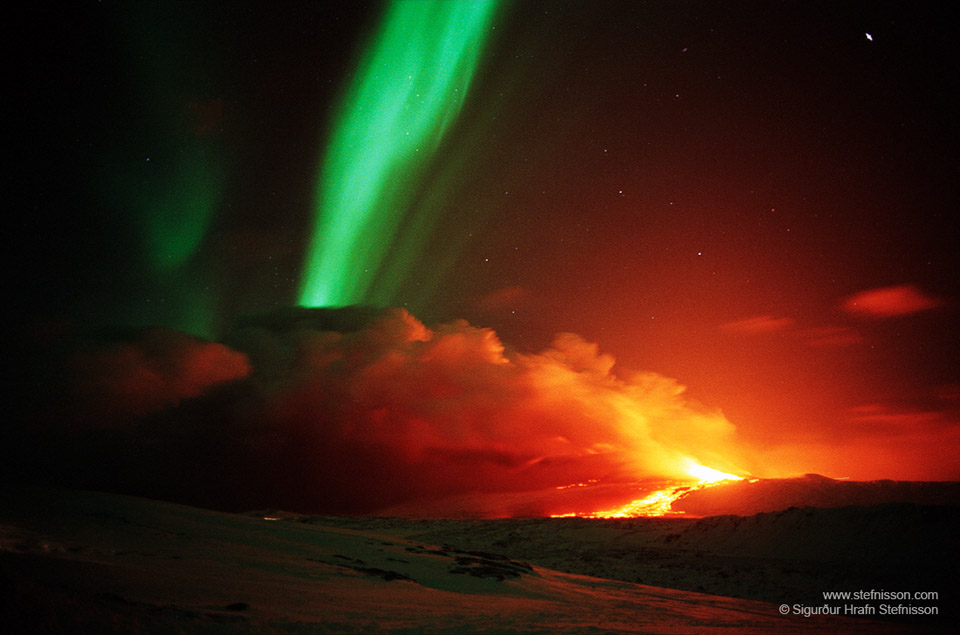
Volcano and Aurora in Iceland
Sometimes both heaven and Earth erupt. In Iceland in 1991, the volcano Hekla erupted at the same time that auroras were visible overhead. Hekla, one of the most famous volcanoes in the world, has erupted at least 20 times over the past millennium, sometimes causing great destruction. The last eruption occurred only twelve years ago but caused only minor damage. The green auroral band occurred fortuitously about 100 kilometers above the erupting lava. Is Earth the Solar System's only planet with both auroras and volcanos? Follow: APOD on Facebook or Google+
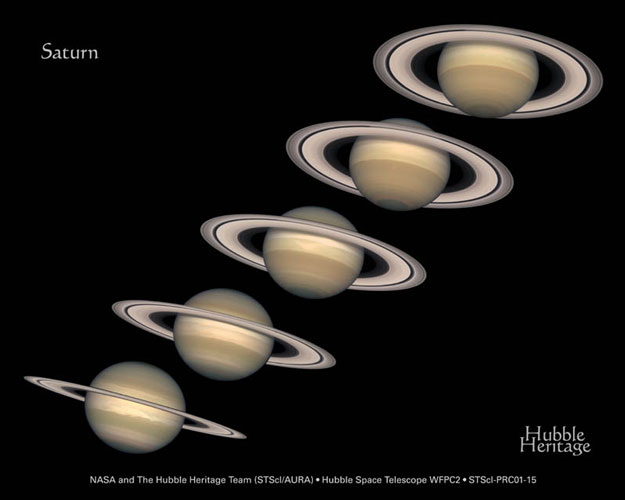
The Seasons of Saturn
Since Saturn's axis is tilted as it orbits the Sun, Saturn has seasons, like those of planet Earth ... but Saturn's seasons last for over seven years. So what season is it on Saturn now? Orbiting the equator, the tilt of the rings of Saturn provides quite a graphic seasonal display. In fact, this month, Saturn's rings will reach their most "open" angle after appearing nearly edge on in the mid-1990s. The ringed planet is also well placed in evening skies providing a grand view as summer comes to Saturn's southern hemisphere and winter to the north. The Hubble Space Telescope took the above sequence of images about a year apart, starting on the left in 1996 and ending on the right in 2000. Although they look solid, Saturn's Rings are likely less than 50 meters thick and consist of individually orbiting bits of ice and rock ranging in size from grains of sand to barn-sized boulders.
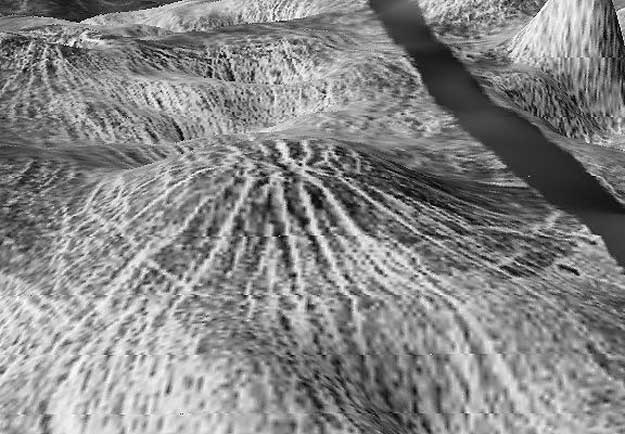
One Hundred-Kilometer Terrain on Venus
ven the hot and cracked surface of Venus has rolling hills. Although never actually photographed from up-close, images of the Venusian surface like that shown above have been constructed in recent years by digitally merging distant photographs from height-sensitive radar. Isolated above is a 100-kilometer wide swath inside a volcanic region known as Yavine Corona. Visible in the frame are numerous fractures in the surface. Data is missing from the dark lane on the upper right. The surface of Venus is so hot and oppressive that robot spacecraft landed there have lasted for only a few hours.
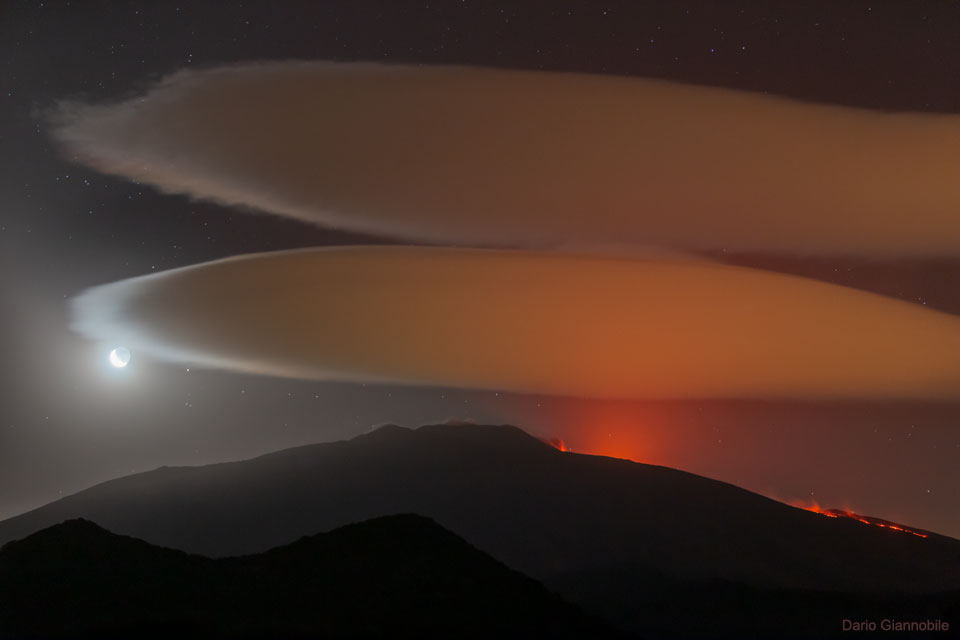
Lenticular Clouds over Mount Etna
What's happening above that volcano? Although Mount Etna is seen erupting, the clouds are not related to the eruption. They are lenticular clouds formed when moist air is forced upwards near a mountain or volcano. The surreal scene was captured by chance late last month when the astrophotographer went to Mount Etna, a UNESCO World Heritage Site in Sicily, Italy, to photograph the conjunction between the Moon and the star Aldebaran. The Moon appears in a bright crescent phase, illuminating an edge of the lower lenticular cloud. Red hot lava flows on the right. Besides some breathtaking stills, a companion time-lapse video of the scene shows the lenticular clouds forming and wavering as stars trail far in the distance. Follow APOD in English on: Instagram, Facebook, Reddit, or Twitter
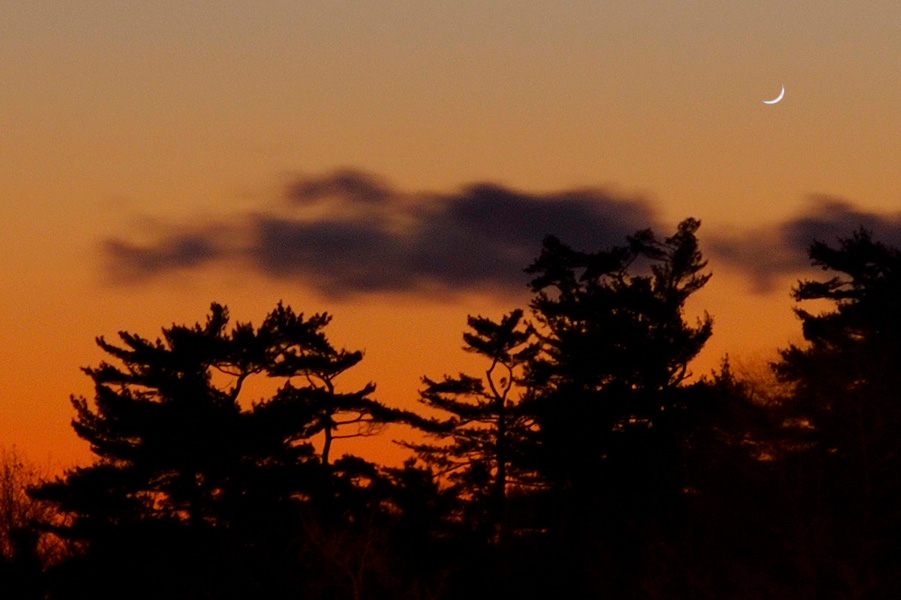
A New Year's Crescent
That's not the young crescent Moon poised above the western horizon at sunset. Instead it's Venus in a crescent phase, captured with a long telephoto lens from Quebec City, Canada, planet Earth on a chilly December 30th evening. The very bright celestial beacon is dropping lower into the evening twilight every day. But it also grows larger in apparent size and becomes a steadily thinner crescent in binocular views as it heads toward an inferior conjunction, positioned between the Earth and the Sun on January 11. The next few evenings will see a young crescent Moon join the crescent Venus in the western twilight, though. Historically, the first observations of the phases of Venus were made by Galileo with his telescope in 1610, evidence consistent with the Copernican model of the Solar System, but not the Ptolemaic system.
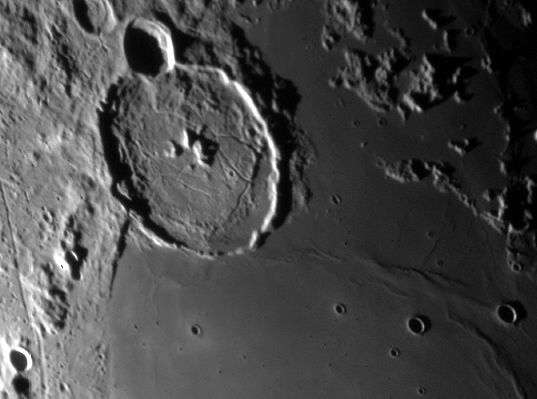
Lunar Close-Up
Late last month, NASA's Lunar Prospector spacecraft moved in for a closer look at the Moon. Now entering an extended mission phase, controllers have reduced the altitude of this polar lunar orbiter from 100 kilometers to about 30 kilometers (18 miles). Having mapped global properties and recorded evidence for water-ice at the lunar poles, the lower orbit allows Prospector's instruments to gather valuable confirming data at higher resolutions. The new orbit is not without some risk, though, and maneuvers are required every 28 days to maintain it. Should the maneuvers fail to be performed, the spacecraft would impact the surface only two days later. This lunar close-up was recorded by the European Southern Observatory's new WFI camera. It shows dramatic shadows and contrasting terrain near the prominent Gassendi crater at the northern edge of the Moon's Mare Humorum.
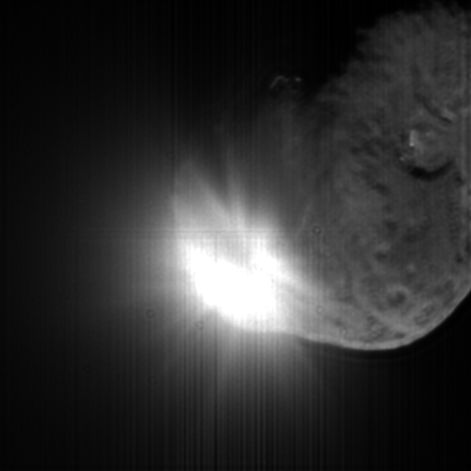
Thirteen Seconds After Impact
Fireworks came early on July 4th when, at 1:52am EDT, the Deep Impact spacecraft's probe smashed into the surface of Comet Tempel 1's nucleus at ten kilometers per second. The well-targeted impactor probe was vaporized as it blasted out an expanding cloud of material, seen here 13 seconds after the collision. The image is part of a stunning series of frames documenting the event from the high resolution camera onboard the flyby spacecraft. Tempel 1's potato-shaped nucleus is approximately 5 kilometers across as seen from this perspective. Cameras onboard the impactor probe were also able to image the nucleus and impact site up-close ... until about 3 seconds before the impact. Of course, telescopes nearer to planet Earth followed the event, detecting a significant brightening of comet Tempel 1.
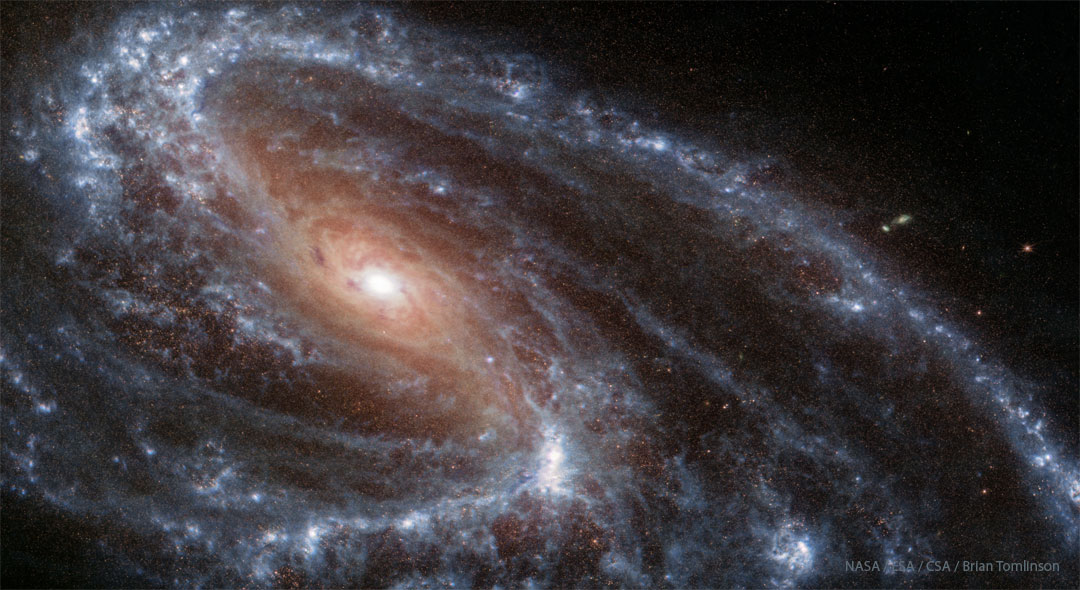
Unusual Spiral Galaxy M66 from Webb
Why isn't spiral galaxy M66 symmetric? Usually, density waves of gas, dust, and newly formed stars circle a spiral galaxy's center and create a nearly symmetric galaxy. The differences between M66's spiral arms and the apparent displacement of its nucleus are all likely caused by previous close interactions and the tidal gravitational pulls of nearby galaxy neighbors M65 and NGC 3628. The galaxy, featured here in infrared light taken by the James Webb Space Telescope, spans about 100,000 light years, lies about 35 million light years distant, and is the largest galaxy in a group known as the Leo Triplet. Like many spiral galaxies, the long and intricate dust lanes of M66 are seen intertwined with the bright stars and intergalactic dust that follow the spiral arms.
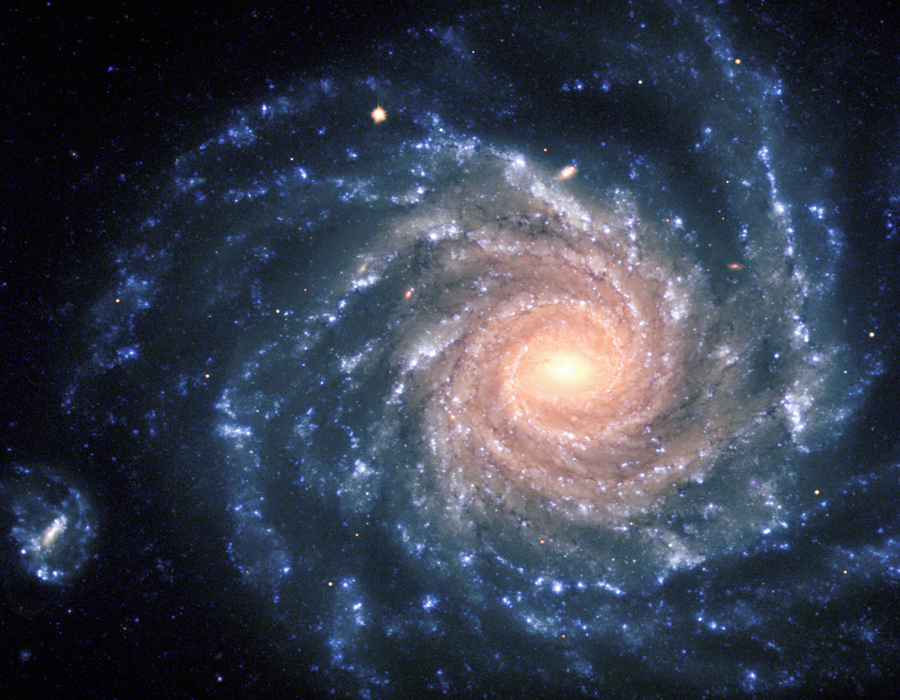
Grand Spiral Galaxy NGC 1232
Galaxies are fascinating not only for what is visible, but for what is invisible. Grand spiral galaxy NGC 1232, captured in detail by one of the new Very Large Telescopes, is a good example. The visible is dominated by millions of bright stars and dark dust, caught up in a gravitational swirl of spiral arms revolving about the center. Open clusters containing bright blue stars can be seen sprinkled along these spiral arms, while dark lanes of dense interstellar dust can be seen sprinkled between them. Less visible, but detectable, are billions of dim normal stars and vast tracts of interstellar gas, together wielding such high mass that they dominate the dynamics of the inner galaxy. Invisible are even greater amounts of matter in a form we don't yet know - pervasive dark matter needed to explain the motions of the visible in the outer galaxy. Discovery + Outreach: Graduate student research position open for APOD
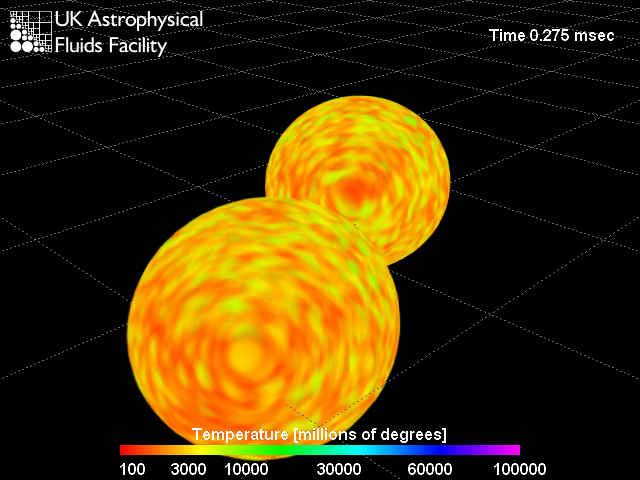
On the Origin of Gold
Where did the gold in your jewelry originate? No one is completely sure. The relative average abundance in our Solar System appears higher than can be made in the early universe, in stars, and even in typical supernova explosions. Some astronomers now suggest that neutron-rich heavy elements such as gold might be most easily made in rare neutron-rich explosions such as the collision of neutron stars. Pictured above is a computer-animated frame depicting two neutron stars spiraling in toward each other, just before they collide. Since neutron star collisions are also suggested as the origin of short duration gamma-ray bursts, it is possible that you already own a souvenir from one of the most powerful explosions in the universe.
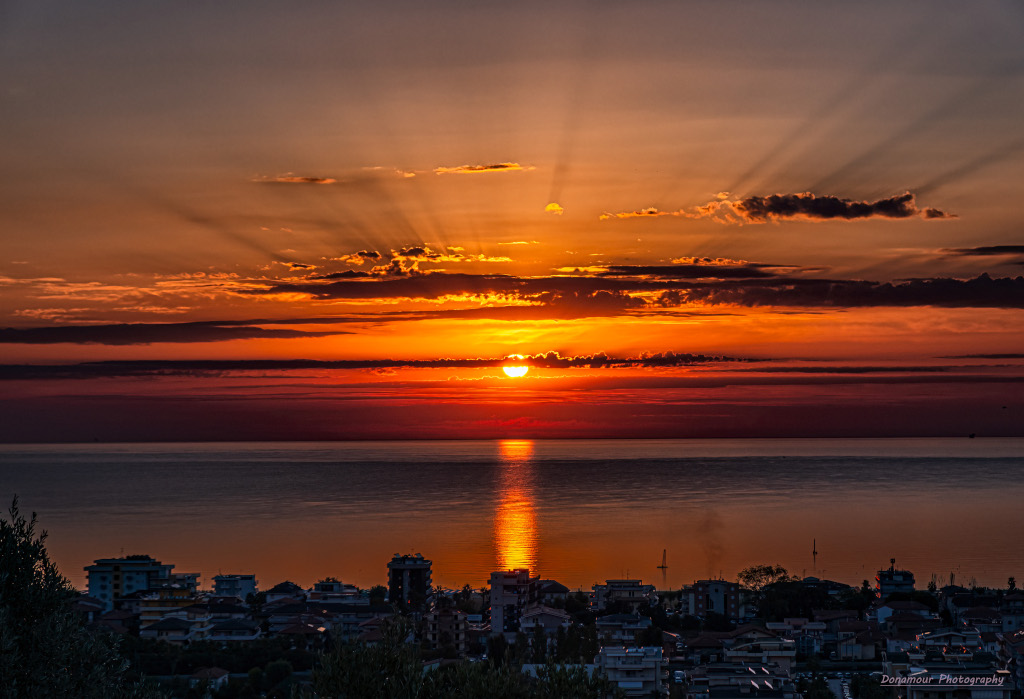
September Sunrise Shadows
The defining astronomical moment for this September's equinox was on Friday, September 23, 2022 at 01:03 UTC, when the Sun crossed the celestial equator moving south in its yearly journey through planet Earth's sky. That marked the beginning of fall for our fair planet in the northern hemisphere and spring in the southern hemisphere, when day and night are nearly equal around the globe. Of course, if you celebrate the astronomical change of seasons by watching a sunrise you can also look for crepuscular rays. The shadows cast by clouds can have a dramatic appearance in the twilight sky during any sunrise or sunset. Due to perspective, the parallel shadows will seem to point back to the rising Sun and a place due east on your horizon near the equinox date. Taken on September 15, this sunrise sea and skyscape captured crepuscular rays in the sky and watery specular reflections from the Mediterranean coast near the village of Petacciato, Italy.
4 Lezioni Gratuite su Come Utilizzare Il Telescopio
Telescopio spaziale Hubble e James Webb
Il telescopio spaziale Hubble, lanciato nel 1990, ha rivoluzionato il campo dell'astronomia, fornendo agli scienziati e al pubblico una visione senza precedenti dell'universo. Per oltre tre decenni, Hubble ha catturato immagini mozzafiato di galassie, nebulose e ammassi stellari, offrendo una comprensione più profonda della formazione e dell'evoluzione delle strutture cosmiche.
Nonostante il suo incredibile successo, il telescopio Hubble è destinato a essere superato dal telescopio spaziale James Webb, il suo successore high-tech. Lanciato nel 2021, il telescopio James Webb è dotato di uno specchio primario di 6,5 metri, molto più grande rispetto allo specchio di 2,4 metri di Hubble. Questo permette a James Webb di raccogliere molta più luce e osservare oggetti più deboli e distanti.
Inoltre, il telescopio spaziale James Webb è ottimizzato per l'osservazione nell'infrarosso, il che gli consente di penetrare nubi di gas e polvere che oscurano la vista di Hubble. Ciò significa che James Webb può svelare i segreti delle prime galassie formatesi dopo il Big Bang, studiare la formazione di stelle e pianeti e persino esaminare le atmosfere dei pianeti extrasolari alla ricerca di segni di vita.
Insieme, il telescopio spaziale Hubble e il telescopio spaziale James Webb rappresentano due delle più grandi conquiste dell'astronomia moderna. Grazie ai loro contributi, gli scienziati continueranno a esplorare e comprendere meglio l'universo che ci circonda.
×
![]()